

Written by Dr Faye Esat, (HDRC Doncaster) and Ben Russell, (Get Doncaster Moving)
Together, HDRC Doncaster and Get Doncaster Moving are exploring how evidence can be made more visible, accessible, and useful for real-world decisions. This isn’t about one side leading and the other following, it’s about meeting in the middle to co-create tools that reflect both research insight and practical experience.
Identifying the Ask
When we talk about evidence in policy and practice, the conversation often gravitates toward academic research. But during an in-person workshop we worked together to facilitate with the Get Doncaster Moving team titled: “Owning Your Research Journey”, something interesting happened. Through activities exploring how teams engage with research, a rich discussion unfolds around a deceptively simple question: what counts as evidence?
It becomes clear that if we want inclusive, reflective decision-making, we need to broaden our lens. For the Get Doncaster Moving team, this meant visually mapping the different types of evidence that inform design, commissioning, and delivery. This isn’t about creating another toolkit; it’s about sparking dialogue and making evidence use more transparent and participatory.
The Digestible Offer
The first step is a simple infographic, co-designed to capture the forms of evidence teams are already using and those they might consider. From there, Get Doncaster Moving adapts it into a one-page resource to share with Doncaster’s Health and Wellbeing Board, using a Doncaster green space as a live example. What starts as a visual prompt becomes a shared learning process shaping and refining together.
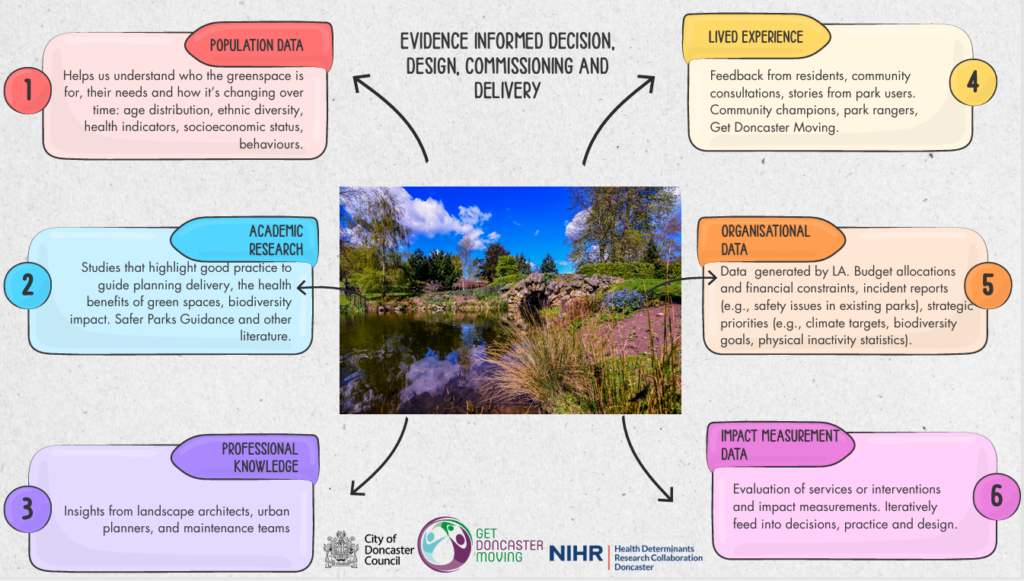
Ben Russell from Get Doncaster Moving summed its value up perfectly:
“This provides a living document which allows gap spotting, evidence building, learning from and adding to”
That phrase, “living document” captures the spirit of this work. It’s not static; it evolves as new insights, data, and experiences emerge. It’s a resource that invites dialogue and continuous improvement, rather than a one-off product.
To strengthen its credibility, work is carried out with one of the HDRC (Health Determinant Research Collaboration) Doncaster’s embedded researchers Professor Andrew Booth (Professor of Evidence Synthesis, University of Sheffield), who not only reviews the infographic but also shares a practical resource, a “Finding Evidence” guide designed to make quick searches easier and more effective. This is a practical guide to quick, reliable sources like King’s Fund Library, Epistemonikos, and TRIP Database which is utilised for sourcing evidence. This tool helps teams access systematic reviews, critical summaries, and good practice examples without drowning in irrelevant search results. It’s a small step, but one that makes evidence feel accessible and actionable.
What Success Looks Like for Doncaster’s Evidence Informed Culture
For us, success isn’t just producing a polished resource. It’s about embedding a culture where evidence is understood as plural and contextual, not just academic. If this work helps Doncaster teams feel more confident using and providing evidence that strengthens officer’ advice and informs elected members decisions, that’s a win. Longer term, success means this approach influencing how local systems think about evidence, and perhaps inspiring similar conversations elsewhere.
Keeping the Infographic Alive
The infographic isn’t a finished product; it’s a living resource by design. It will continue to evolve as new insights, data, and experiences emerge. Rather than sitting on a shelf, it’s intended to spark ongoing dialogue and function as a practical decision-support process, helping teams rapidly visualise the types of evidence available and identify gaps before choices are made.
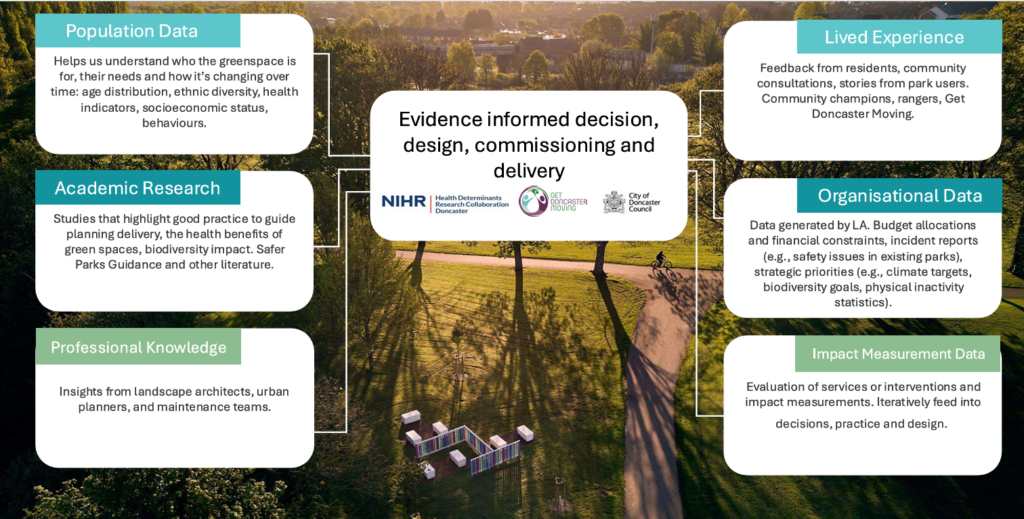
Alongside the visual, we’ll capture the learning journey, the questions we ask, the tensions and trade-offs we encounter, and the insights that emerge, in simple, shareable formats so others can build on, adapt, and test the approach.
We’re also exploring interactive features that make the resource adaptable for different projects, shareable across teams, and a prompt for reflective conversations about what counts as evidence in practice. In short, the aim is to keep evidence visible, digestible, and actionable for everyone involved in shaping Doncaster’s health and wellbeing priorities in decisions, commissioning, and redesigns.
Why This Matters for Local Decision-Making
Doncaster’s investment in parks and green spaces isn’t just about aesthetics, it’s a drive to reduce physical inactivity by supporting health, wellbeing, civic pride and equity. These spaces influence physical activity, mental health, and community cohesion. Decisions about their design and use need to be grounded in multiple forms of evidence: lived experience, local data, and academic research. A key foundation to the Future Parks work is Sport England’s Active Design Guidance which is layered with complementary frameworks such as ‘Safer Parks: Improving Access for Women and Girls’ guidance. These are research-backed resources underpinned by University of Leeds research studies, and provide a practical mechanism for engagement, design and delivery. By using and accessing evidence such as this, the principles help frame conversations with teams and shape decisions around green space redesigns.
By making evidence digestible and visible, the infographic and supporting resources strengthen officers’ advise and help local decision makers move beyond assumptions and towards evidence informed choices. They provide a quick way to see what’s already known, identify gaps, and spark conversations about what counts as credible evidence in practice. This matters because better evidence leads to better decisions, and ultimately, better outcomes for communities.
Join the Conversation: Explore, Share, Reflect
Evidence isn’t just something for academics or policy papers, it’s a practical tool for better decisions. That’s why we’re using Professor Andrew Booth’s clickable “Finding Evidence” resource, a tool he developed to help practitioners access trusted sources quickly. It’s now embedded in our approach to make evidence more digestible and actionable.
Take a few minutes to explore it. Try it out the next time you need to check what evidence is out there or you want a speedy summary to support your case. Then share it with colleagues, because, as Professor Andrew Booth reminds us:
“Enriching your work with just a little evidence from a few minutes’ search, can be the difference between an informed decision and a definite wrong one.”
We’d love to hear how you use it. Does it change the way your team thinks about evidence? Have you used a ‘living resource’ as a medium for knowledge exchange and learning? What other tools or approaches have helped you make evidence more accessible? Join the conversation by starting your own ‘living resource’ conversation. Reflect on what counts as evidence in your context and let’s keep building practical ways to make evidence work for real-world decisions.
Y-PERN would like to thank Faye and Ben for sharing their insights.