
Written by Kersten England CBE DL
Throughout my career in local government – 14 years as a Chief Executive – I’ve been asked to tackle issues that have no simple answer, issues that no single organisation could possibly solve alone. Whether responding to community tensions, rebuilding trust after public disorder, or navigating a pandemic, the formula for success has always been the same: bringing together coalitions of the willing who work across boundaries, hierarchies, and labels to craft solutions alongside communities.
The challenge, of course, is: can you do that in peacetime? Can you build the habits, the governance, the networks that make collaboration the day job rather than the emergency response? That’s fundamentally what Y-PERN is about.
The creation of the Yorkshire and Humber Policy and Engagement Research Network (Y-PERN) was founded on a simple but powerful premise: the complex challenges facing Yorkshire and the Humber are better met when academic expertise works hand-in-hand with the deep knowledge held within our local and combined authorities. The signing of a memorandum of understanding between Yorkshire’s universities and councils across Yorkshire and the Humber wasn’t just a formal agreement – it was a commitment to make collaboration the norm, not the exception.
Why This Evaluation Matters
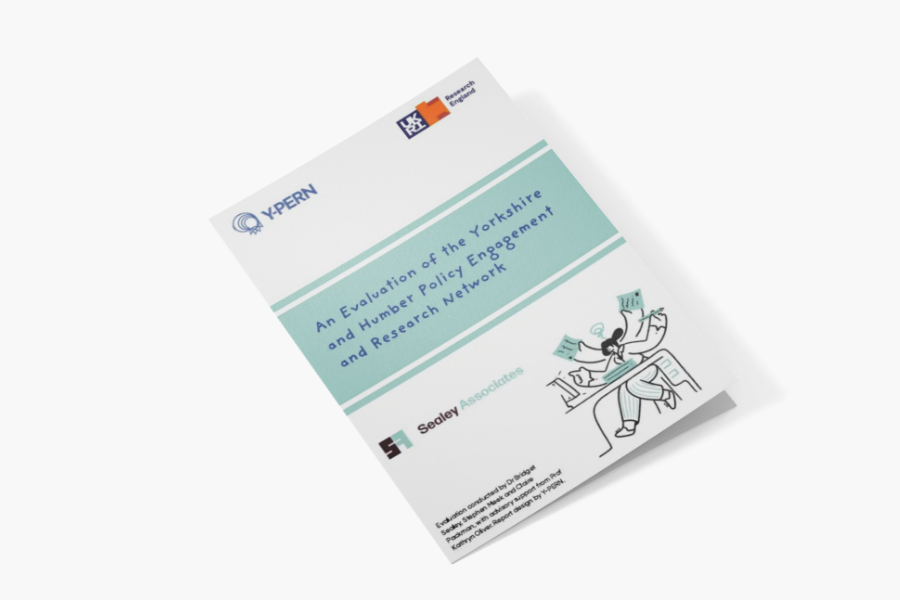
During the Spring of 2025, Sealey Associates undertook a rigorous evaluation of Y-PERN. This wasn’t a box-ticking exercise. The evaluation team conducted 53 interviews, held multiple workshops, and examined Y-PERN against seven distinct outcomes. We needed to understand what was genuinely working, what wasn’t, and why – because there’s no substitute for honesty about impact.
This level of scrutiny matters because Y-PERN is doing something different – bringing together 12 universities, 15 local authorities, and 4 combined authorities in a genuine ‘network of networks’. We’re talking about a region the size of Scotland, over 5.6 million people, with considerable knowledge and capacity across our institutions. The question has always been: can we actually work together to deploy those assets where they’re needed most?
What We’ve Learned: Key Strengths
The evaluation reveals encouraging findings. Decision-making has become more resilient through cross-sector collaboration. Policy Fellows – particularly when embedded or bringing deep expertise – have proven effective at bridging different worlds, helping authorities articulate research needs, contributing to growth strategies, and operating as ‘honest brokers’ building consensus on evidence.
Y-PERN has generated projects and outputs that would not have otherwise happened – not necessarily because the work wouldn’t have been done, but because Y-PERN made a decisive difference to the breadth and rigour of insight. We’re building trust and shared purpose: the intangible foundations without which formal structures achieve little.
The evaluation also identified challenges. Awareness at senior levels remains patchy. Some policy stakeholders felt uncertain about their role in steering projects. The ‘network of networks’ concept, while useful internally, can obscure what matters to partners: the offer itself.
Moving Forward
The evaluation’s recommendations are clear: greater co-ownership with policy partners, continuity of resources and relationships, flexible programme management that adapts to political change, and clearer definition of what we offer and where we add most value. We need investment in central knowledge brokerage – the capacity that makes connections across the region and helps partners navigate available support.
Y-PERN has already contributed to leveraging nearly £10 million for knowledge mobilisation across Yorkshire and the Humber. But sustainability isn’t just about funding streams. It’s about whether we’ve built something that genuinely improves how decisions are made, and ultimately the lives of people and communities here.
Acknowledgements
My thanks go to Dr Bridget Sealey, Stephen Meek, and Professor Kathryn Oliver for their rigorous evaluation work, to our policy fellows, and to all the Y-PERN team and partners. What unites us is commitment to work not simply as organisations pursuing our own objectives, but as partners dedicated to improving lives across Yorkshire and the Humber. This evaluation helps us understand how well we’re doing that, and what we need to do better. That shared purpose – and that shared honesty – is both our foundation and our future.
Read our full phase one Evaluation report here >