Y-PERN 2025 Conference: Bridging Academia and Policymaking

Register now for your ticket for the Y-PERN 2025 Conference on June 27th at the Oastler Building in Huddersfield!

We invite scholars, policymakers, and community leaders to engage in vital discussions surrounding academic-policy collaboration aimed at regional development.

The conference will bring together leading academics, policymakers, and practitioners to explore innovative approaches to incorporating academic academic research into impactful policies. With confirmed speakers including Tracy Brabin, Mayor of West Yorkshire, and Robin Tuddenham, Chief Executive of Calderdale Council and President of Solace, the day will include stimulating panel discussions, insightful case studies, and interactive sessions aimed at fostering meaningful dialogue and collaboration. These activities will help us explore ways to achieve multi-level growth, promoting fairer, greener, and more inclusive futures.

The conference will begin at 9 AM with a welcome session led by Professor Tim Thornton, the Deputy Vice-Chancellor of the University of Huddersfield. Our guest speakers will include Kersten England, Chief Executive Officer of the City of Bradford Metropolitan District Council; Harpreet Uppal, Member of Parliament for Huddersfield; and Tracy Brabin, Mayor of West Yorkshire.

The agenda includes engaging discussions on the evolving relationship between universities and policymakers, showcasing the impact of the Yorkshire and Humber Policy Engagement and Research Network (Y-PERN). Participants will explore Y-PERN network’s collaborative approach, engage in interactive breakout sessions which tackle key regional policy challenges, and will be invited to share ideas for future growth strategies. Themes will include early years education, community inclusion, business support, and housing solutions.

A pivotal focus will be placed on the evolving dynamics of university-policy engagement within the context of a rapidly changing policy landscape. Participants will examine how such collaborations can effectively respond to emerging opportunities and challenges.

The 2025 conference will serve as an important platform for networking among influential speakers, researchers, and organisations committed to fostering effective policymaking. The discussions at the conference are expected to yield insights into practical, evidence-based policy frameworks that can facilitate multi-level growth. By harnessing collaborative efforts, the aim is to create more inclusive, sustainable, and resilient communities across Yorkshire and the Humber.

To view the full agenda and to register for your free ticket, please visit our Eventbrite page.

The event is being delivered by Y-PERN with support from the team at Social. If you have any questions or require further information, please email them on [email protected].

Making sense of the busyness: Yorkshire & Humber networks for research-policy engagement

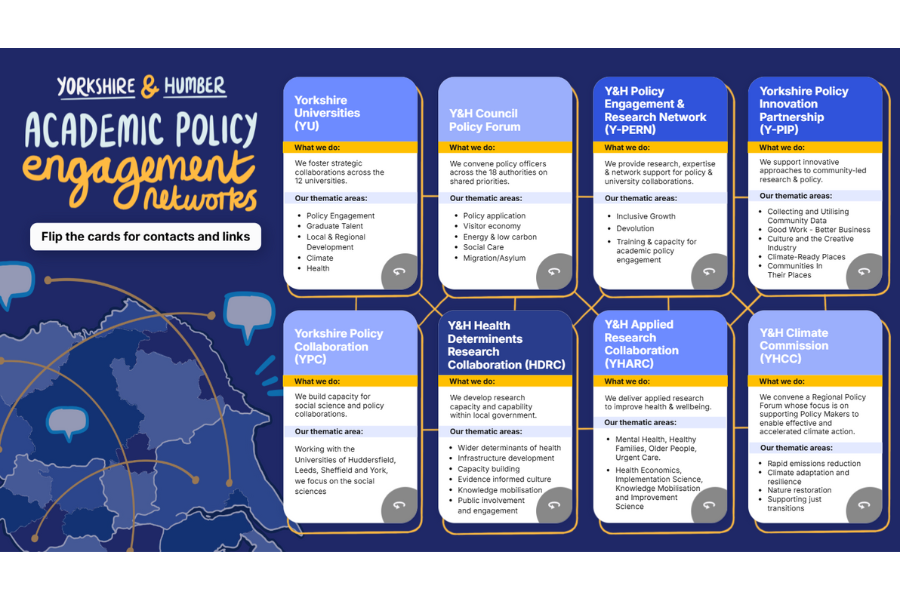
Following a Yorkshire & Humber Networks event in February at Doncaster Council, we are delighted to be able to share with you an interactive visual tool that helps articulate some of the region’s networks that are supporting research-policy engagement.

The networks covered include:

  • Yorkshire Universities
  • Yorkshire & Humber Councils Policy Forum
  • Y-PERN
  • YPIP
  • YPC
  • Yorkshire & Humber Applied Research Collaboration
  • Health Determinants Research Collaborations
  • Yorkshire & Humber Climate Commission

To view this tool in a larger format click here

You can also find an overview of our discussions visually presented below – and read up about our key takeaways in this Y-PERN blog.

For further information, please contact Kayleigh Renberg-Fawcett (Senior Programme Manager) on [email protected]

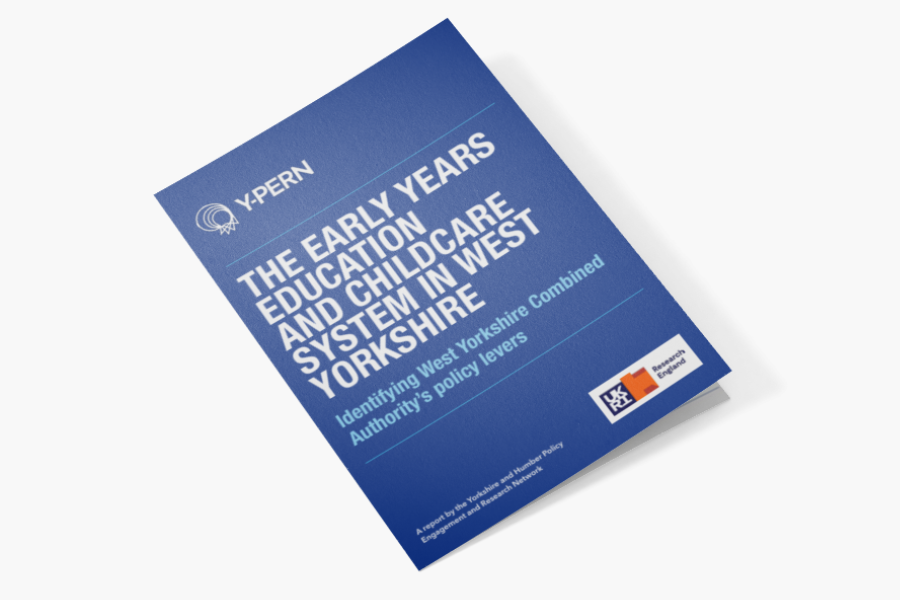
Early Years Education and Childcare System in West Yorkshire Report

Y-PERN and West Yorkshire Combined Authority present a report on the early years and childcare system in West Yorkshire. Written by Y-PERN Policy Fellow Dr Tom Haines-Doran and a research team comprising of Karen Arzate Quintanilla, Dr Lilith Brouwers, Dr Jo Burgess, Dr Aimee Code, Dr Amy Creaser, Dr Erin Dysart, Dr Jack Simpson and Dr Claire Smithson.

The West Yorkshire Local Growth Plan, has identified early years education and high-quality childcare provision as key enabling policy areas for an inclusive economy, performing a dual role for families:

1. High-quality early years education can transform the life chances of children, reducing entrenched inequalities at the earliest opportunity.

2. Affordable and available childcare enables greater parental and carer participation in the labour market, especially for women.

The Yorkshire and Humber Policy Engagement and Research Network (Y-PERN) has led new research, bringing together national and regional evidence and taking a systems mapping approach for the West Yorkshire Early Years Education and Childcare sector.

The research found that the Early Years Education and Childcare sector in West Yorkshire is led by providers, their workforce and Local Authorities that are exceptionally dedicated to the education and care of children and their families.

However, the research also found that providers and key stakeholders face considerable challenges in a very complex system.

Affordability for parents remains an issue despite increasing funding entitlements, as does navigating the entitlements, financial support and local availability of places.  

Current funding entitlement for childcare disproportionately benefits higher earning families. Families on the lowest incomes are seeing virtually no direct benefit from increased entitlements because entitlements focus on families with working parents and some providers target wealthier areas for expansion

Workforce challenges reflect national trends and include:  

  • Low recruitment and retention
  • Poor pay
  • Lack of progression opportunities
  • Lack of training and development opportunities (e.g. around special educational needs and disabilities (SEND) and caring for very young children)  
  • A highly gendered workforce and a lack of diversity  

The government is seeking to ‘break down barriers to opportunity’ with a focus on the Early Years Education and Childcare sector and the continued roll out of childcare entitlements for working parents on a national level.

The Y-PERN research report offers new insights into how West Yorkshire Combined Authority can best support the revitalisation of the Early Years Education and Childcare sector, alongside Local Authorities and providers.

Through a ‘systems mapping’ exercise, undertaken in conjunction with Early Years Education and Childcare academic experts, providers and West Yorkshire local authorities, Y-PERN researchers identify three regional ‘policy levers’ that the Combined Authority could engage to improve Early Years Education and Childcare quality and accessibility:

  1. Political leadership and advocacy. Many of the challenges facing the Early Years Education and Childcare sector result from under-funding, despite recent increases in ‘entitlements’. The Combined Authority could champion the sector on a national level, while convening providers and local authorities on a regional scale to help overcome fragmentation and unevenness in the system. It could also consider whether targets based on outcomes may be appropriate, to help direct policy.
  2. Information sharing and systemic analysis. Making good policy and making choices as parents relies on good data, but this is unavailable in many key areas, especially at a West Yorkshire scale. The Combined Authority could work with the sector, local authorities and academics to identify where greater data availability could add value to policy, practice and parental choice.
  3. Creation of a West Yorkshire Early Years Education and Childcare workforce strategy. The sector relies on a dedicated workforce, which is too often under-paid, under-prepared and under-appreciated, resulting in a recruitment and retention crisis. The Combined Authority could help to remedy this through a regional workforce strategy that improves both recruitment levels and training provision. Among other priorities, recruitment should aim to increase male representation from low levels. Training should target key challenges, for example around SEND provision and caring for very young children, to improve outcomes and help retain staff.

As an immediate and direct response to the third identified regional lever, the Combined Authority has commissioned Bradford Birth to 19 Institute for the Early Years, to develop an evidence-based, practical workforce plan rooted in the region. The plan will identify practical, implementable steps to address key challenges around recruitment and retention, training, development and progression as well as diversity of the workforce.

Tracy Brabin, Mayor of West Yorkshire, said:

“I welcome this first of its kind report from the Yorkshire and Humber Policy Engagement and Research Network, and we are already taking action to respond to the recommendations.

“The evidence is clear – our early years sector in West Yorkshire and across the country is facing significant challenges, and we must take action now to address the concerns of a workforce that is undervalued and underpaid, and of families who deserve consistent and high quality childcare services.

“Faced with unprecedented funding pressures, our councils cannot be asked to meet this challenge alone. Devolution is the green shoot of hope that can empower our region to invest in the early years workforce we need, to set our children on a path to success and sow the seeds of a stronger, brighter West Yorkshire.

“We have commissioned a regional workforce plan for early years education that will enable us to tackle the urgent challenges around recruitment and retention head-on, and we are flexing our adult skills funding to deliver training, development and progression opportunities within the sector.

“But we have so much further to go, and we will continue to work alongside the sector, our councils and the government to make sure that our great region has the powers and funding it needs to build an Early Years Education and Childcare system that works for both parents and practitioners.”

Christian Bunting, Executive Director at Bradford Birth to 19, said:

We are really excited to be doing this work with the Combined Authority. As a team of Early Years professionals, who are passionate about improving the workforce and in turn improving outcomes for children, we have genuine interest in this work and the drive to ensure that the positive impacts of this project are maximised.”Birth to 19 Institute for the Early Years is the training, sector improvement, research and policy arm of St Edmund’s Nursery School, a maintained Nursery School in Bradford judged Outstanding by Ofsted. The nationally recognised organisation improves outcomes and increases social mobility for children through school and setting improvement, training and qualifications, guidance, and cutting-edge educational initiatives.

The Y-PERN report has also already informed strategic commissioning decisions of the Combined Authority around Skills Bootcamps. Over 200 places to train Early Years Educators are being commissioned, and the training includes a focus on equipping practitioners with knowledge of SEND, speech and language and how to work with the youngest children, following the findings in the report. Three organisations have commenced delivery, including Kirklees Council which has already seen 80% of participants secure interviews in the sector.

You can read the report here: The Early Years Education and Childcare system in West Yorkshire

Putting health at the heart of your local economy

This article was first published on the Yorkshire Universities website.

The NHS Confederation recently hosted a webinar focused on the local growth agenda, the role of acute trusts, and how they can influence local leaders. Y-PERM Policy Director and Yorkshire Universities (YU) Executive Director, Dr Peter O’Brien, was invited to speak at the event to provide broad insights from the higher education sector and regional perspectives from higher education institutes within Yorkshire and the Humber.

The session was chaired by Michael Wood, Head of Health Economic Partnerships at the NHS Confederation, who led the discussion. Christopher George, Health Economic Policy Advisor, also gave a presentation on ‘The NHS as an Economic Actor: The role of the NHS in the Economy’. Accompanying panel members included Mark Rogers, Chief Executive at the Leadership Centre, and Kathryn Lavery, Chair of Rotherham Doncaster and South Humber NHS Foundation Trust. Alongside panel members, Peter addressed multiple questions covering collaboration and partnerships, civic goals and local communities, devolution and stability, regional powers and local authorities, financial challenges, and the importance of networks in combating health inequalities.

This webinar supports YU’s work in health & wellbeing, bringing together knowledge to inform our current and future projects. Previous work between YU, the NHS Confederation, and Health Innovation Yorkshire & Humber,  includes the development of the YHealth4Growth white paper. The paper was presented in Parliament, in October 2024, to show how Yorkshire can provide a “blueprint” for the new Labour government, regional mayors, and businesses to address health and economic equalities that cost UK plc at least £180billion a year.

You can download the webinar presentation slides here, which provide details on the NHS as an economic actor and presents a new framework centered around economic growth – in line with the Government’s central mission.

Smaller and Specialist Universities Workshop

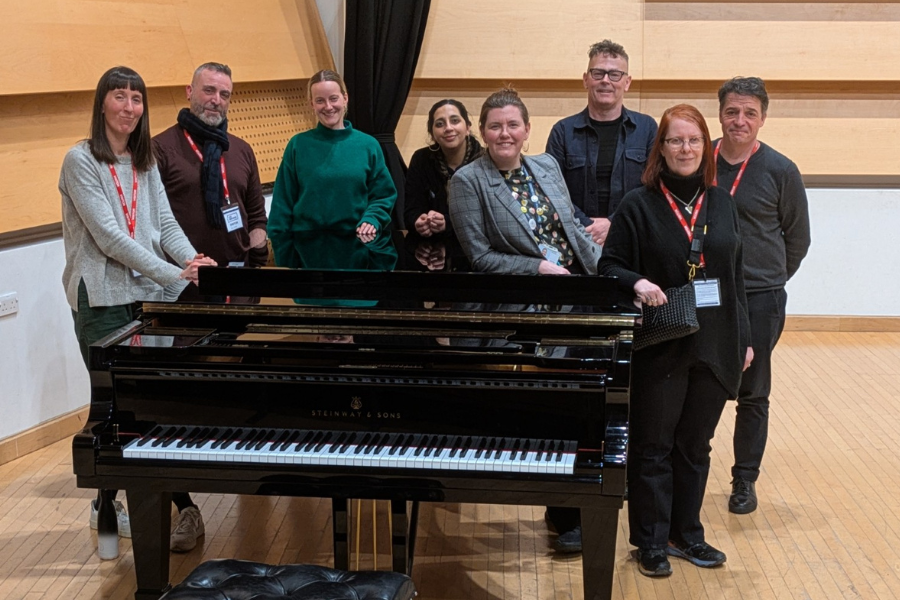
On Tuesday 18th February, leaders and representatives from Y-PERNs smaller and specialist universities met at Leeds Conservatoire to explore the specific challenges and opportunities they faced in undertaking academic policy engagement. Participants from Leeds Arts University, Leeds Conservatoire, Leeds Trinity University, and York St John University discussed how Y-PERN can best build capacity, resources, and activities that provide value to them and the wider Y-PERN network while enhancing their unique role and contribution.

It was noted that there was widespread appreciation amongst smaller and specialist universities for their shared association of Y-PERN and feeling part of a network that larger universities sit within. There was though a divide between larger Y-PERN institutions that measure impact of policy and our specialist and smaller universities who focused predominantly on developing graduate skills, retention and employability and also professional practitioner expertise through teaching and research.

Participants highlighted that the extensive expertise of smaller and specialist universities is not always research focused, so can sometimes be more difficult to identify and value in more typical forms of academic policy engagement. This expertise is however deeply valued by policy partners and can inform evidence-based policymaking as impactfully as more traditional research policy collaboration and knowledge mobilisation.

For example, Leeds Conservatoire have invested considerable time in curating and maintaining practitioner-based networks such as the West Yorkshire Music Network which evidence the impact of expertise-led policy engagement working with broad range of policy, public sector, business, voluntary organisations, charities, and community groups associated with arts, heritage, and culture. However, there was a need to enhance the resonance of creative and cultural economy and better integrate with other areas of social and economic policy such as health, transport, crime, and local growth.

The workshop also explored issues of resource and capacities associated with smaller and specialist universities. It was noted that there are many factors to consider, such as staff time, budgets, and the organisational structuring (with some of our universities not having specific research or knowledge exchange capacity). It was noted that what resources are available must be focused on areas of activity that promote student recruitment and the distinctive areas of research which connect to teaching and practice-based professional development. There was as such a need to adopt a more agile and adaptable approach to support smaller and specialist universities that appreciates such challenges and reflected their diversity of key interests.

One key area identified which was seen as delivering value and impact to Y-PERN’s smaller and specialist universities is the training of academic and professional staff to better engage in its work. Y-PERN and its partner universities have hosted a range of training activities and events. It was acknowledged however that there was a need to scale up training activities to develop expertise as this would allow for more opportunities to undertake policy engagement to be realised.

Colleagues from York St John University noted that the York Policy Engine had provided several opportunities including two members of staff participating in York Policy Academy programme at the University of York and other training initiatives. Participants encouraged other larger Y-PERN universities to support smaller and specialist universities in similar ways to support extended peer-to-peer learning across the network, with larger universities representing the interests of smaller and specialist universities in conversations they are not present at.

The workshop participants also discussed how to work more closely with Y-PERN’s Policy Fellows to enhance the resonance and impact of expertise and network building provided by smaller and specialist universities. It was noted that they could play a key role in the developing of Areas of Research Interest (ARIs) and multi-partner communities of practice at a local and regional level, both in shaping existing policy areas and in developing creative and cultural ARIs. They also considered how they might develop staff exchanges and secondments to policy units within the larger universities and with local and combined authorities.

The workshop concluded by identifying several proposals to draw on and address some of the key issues discussed. A short report for publication will be produced from the workshop and Y-PERN will report findings back to relevant stakeholders with recommendations for future policy engagement collaborations with our smaller and specialist universities.